
Happy 4th of July 🇺🇸 where we in the
United States of America celebrate “Independence Day”
Are you going to be like Bill Pullman?
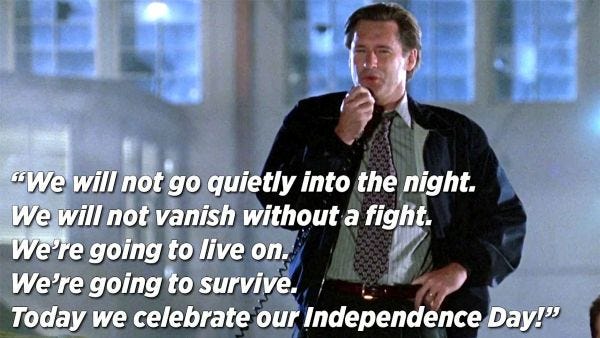
Or are you going to be like Bill Paxton?

Introduction: Technology vs. People Strategies
The transition into an AI-driven economy is creating a dual challenge: enormous opportunity on one side, and real disruption on the other. AI may help improve productivity, support discovery, and open new industries, but it is also reshaping entry-level work, professional training, and the pathways people have traditionally used to reach middle-class stability.
Recent Pew Research Center findings help explain why so many people are uneasy. About half of U.S. adults now say they use AI chatbots, yet majorities still think AI is advancing too quickly and will make personal information less secure. In other words, public adoption is rising even as public trust remains fragile.1
The United States has a technology strategy for AI. What it still lacks is a broad people strategy: a plan for how workers, students, and communities adapt when routine cognitive work changes faster than institutions do.
Learning from the Scars: The Manufacturing Decline
The decline of American manufacturing remains a cautionary tale about what happens when transition is left largely to market forces. For many workers, the loss was not only financial but also social and personal: a job was (and is) tied to identity, dignity, and community stability. That is one reason the “just get a new job” response often fails; it assumes workers can pivot without support, even when the surrounding economic ecosystem is collapsing.
This matters for AI because the pattern could repeat. If we treat displacement as a private problem rather than a public transition, the result may be avoidable damage to families, local economies, and civic trust.
A Better Precedent: Post-WWII Planning
There is another historical model worth remembering. During and after World War II, business and civic leaders did not wait passively for the labor market to reset; they organized institutions to think about how returning soldiers and service members would re-enter civilian life. That kind of coordinated planning is what a serious transition strategy looks like.
The lesson is not that every transition can be managed perfectly. It is that outcomes improve when institutions anticipate disruption, build pathways back into work, and treat workers as assets rather than excess labor.
The Judgment Economy
We are moving from an era centered on routine data processing toward what might be called a judgment economy: a labor market where human value comes increasingly from context, discretion, synthesis, and trust. In this economy, the most important skills are not just technical execution, but the ability to interpret incomplete information, coordinate people, and make sound decisions under uncertainty.
A useful way to think about this is to define metacognition. In plain English, this is the ability to notice how you are thinking, check whether your thinking is accurate, and adjust when it is not. Put another way, metacognition is the habit of pausing before acting and asking, “Do I understand this? What am I missing? Should I verify this before I move forward?”
That matters because AI can generate answers instantly, but human judgment still has to decide whether those answers are relevant, correct, and appropriate. A person using metacognition is not simply accepting machine output; they are evaluating it.
Three human skill categories stand out in this new environment:
Interpersonal alignment: The capacity to build trust, resolve conflict, and move different stakeholders toward a shared purpose.
Strategic interpretation: The ability to read weak signals, infer what is not stated, and make decisions under uncertainty.
Creative synthesis: The ability to combine insights from different fields to create new solutions.
Associated Press reporting highlights this same direction, noting that workplace experts see empathy, nurturing relationships, critical thinking, and other distinctly human traits as areas where people still outperform AI. That does not prove every employer will hire for these skills in the same way, but it does show a growing consensus about where human advantage remains.2
Intentional Planning: The RAISE US Model
That is where RAISE US enters the picture. The organization says it was launched to help the American workforce make a successful transition to an AI economy, and its public framing closely matches the “people strategy” idea. Its emphasis on state government, employers, and training partners suggests a practical attempt to build transition infrastructure rather than merely debate the future of work.


The point is not that one initiative can solve everything. The point is that the AI transition will require public/private partnerships that connect education, training, employers, and policy if workers are to move into new roles without being left behind.
Conclusion: The Human Advantage
Economic history suggests that the outcome of major transitions is shaped less by technology alone than by institutions, preparation, and the quality of the response. AI can automate many routine tasks, but it cannot replace the full human capacity to judge context, navigate ambiguity, and understand long-term consequences.
That is why the most durable advantage in an AI economy may not be speed or scale. It may be judgment — the ability to think about one’s own thinking, correct course, and make decisions that remain sound when the data is incomplete.